
The creative female-led projects fighting for equality

In 2016, we published an article discussing the lack of representation for women in the design industry. The statistics were depressing: 78% of designers were men, and 41% women in design were paid less than £20,000 per year, compared to 26% of men.
Three years on, and things have remained much the same. Recent research analysed by the Design Museum found that the percentage difference between male and female designers hasn’t changed, with just 22% of design roles occupied by women.
Even looking back as far as 2004, it’s clear that little progress has been made. The number of women working in design has only risen by 4% in the last 15 years, with underrepresentation seen across every discipline.
This is despite the fact that girls currently make up almost 70% of A Level entrants in design-related subjects. There are evidently young women who aspire for careers in design. Yet once they enter the working world, their ambitions are stifled by a long-standing and outdated tradition of male dominance.

The Co-Foundry is proud to be a female-led design agency. We strongly believe that women have valuable and innovative contributions to make to our field. When given the chance to lead, women thrive. Yet the next generation aren’t being given the chance to prove themselves.
As International Women’s Day approaches, we wanted to revisit the topic of underrepresentation for women in design, and see what’s being done at a grassroots level to change things. Perhaps through projects like these, there’s hope for gender equality to be achieved.
Empowering female communities
New York-based designer Jessica Walsh founded Ladies, Wine & Design as a place for women to encourage and support one another in their creative professions. By seeing other female designers as allies instead of rivals, LWD chapters in over 200 cities around the world challenge issues such as sexism, underrepresentation and the gender pay gap as a united front.
Jessica explains her reasons for starting LWD in an article on her website. “The fact that we are still focusing on women’s appearances instead of our talents or merits is obviously not helping,” she writes. “If we’re all being sexist – even women ourselves – how can we hope to end these ridiculous, insulting stereotypes?”
Changing the discourse from one of competition to collaboration is one of LWD’s key aims. Women like Jessica show that by forming engaged communities of female designers, we can work together to achieve change.

Amplifying female voices
“The simplicity of seeing a woman talk about her design work can have an enormous effect on the people watching and listening,” says Emma Blackburn, MD of the West England Design Forum and founder of gender equality initiative Up!. The group aims to champion women in design professions, providing a platform for their voices to be heard.
“In recent years WEDF have made a concerted effort to scout out and encourage women to speak at our events,” Emma continues. “This is to instil confidence in other women and give them the courage to talk on a stage; to challenge the notion that a woman on a panel is a ‘token’ of diversity; but mainly because woman create fantastic design solutions and run successful design businesses.”
Up! recognises the institutional barriers that often prevent women from furthering their careers. By embracing shared parental leave, encouraging mentorship for women and promoting the benefits of flexible working for both genders, Emma and her colleagues envision a world where groups like Up! are no longer needed.
“We know that one of the most powerful things we can do is to encourage local design leaders to be open and communicative about how they’re supporting women working in design on a practical level,” Emma adds.
“To quote former WEDF vice chair Lynne Elvins, ‘teams with more women demonstrate higher collective intelligence and bigger innovative success. Diversity encourages the search for new information and perspectives. It leads to better decisions and a greater level of problem solving.’ Surely this is the holy grail for all good designers?”
Promoting female leadership
The disproportionately small percentage of female leaders in design isn’t just unfair; it’s also suppressing diverse ideas that could change our industry for the better.
Motivated by the fact that only 11% of women are creative directors, London-based collective Kerning The Gap helps aspiring female designers to reach their potential and promotes discussion about the need for more women in senior roles.
In a column for Design Week, Kerning The Gap founder Natalie Maher explains her reasons for taking a stand against the lack of diversity in creative leadership. “Half of the challenge we have – 89% of it, in fact – is the current lack of women in leadership positions, who act as vital role models, and bring first-hand experiences of their own challenges to help reshape the legacy behind them.”
With more women in leadership positions, it’s possible that more female designers would recognise their potential to achieve similar levels of success, and strive for greater impact in the industry.
As Natalie points out, “We urgently need men and women to be equal parts of the solution. Whatever your gender, if you’re in a leadership position, you need to ask yourself if you’ve pulled the ladder up behind you; if you’re doing everything you can to boost diversity (of every form) in your leadership team.”
Happy Anniversary! Books for brands
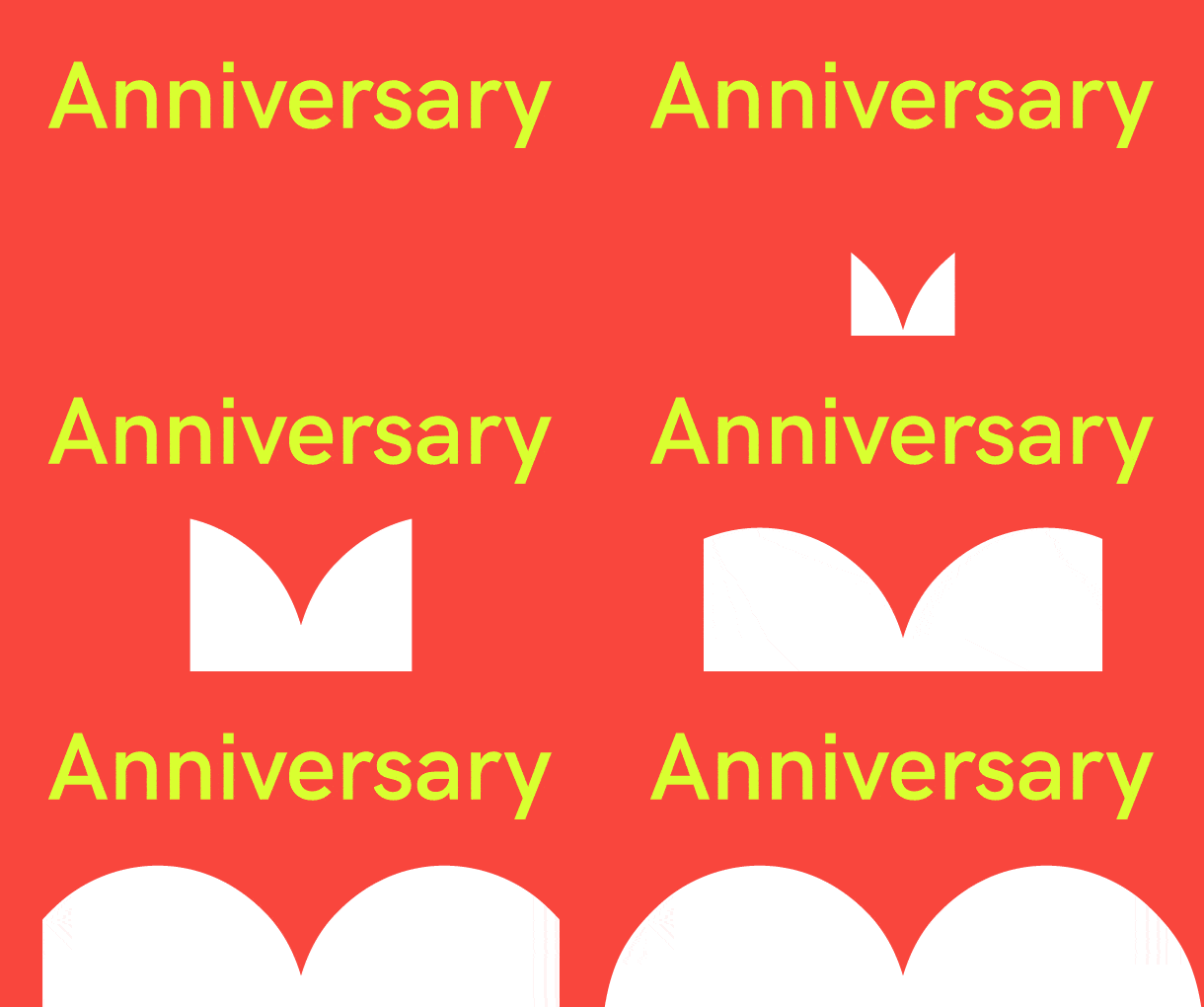
On February 5th 2019, Facebook celebrated its 15th birthday. This milestone for the social-media giant made the news all over the world. Why was it so important?
Facebook’s anniversary provided the company with an opportunity to remind us of our part in its journey. If our loyalty has waned a bit, seeing all that coverage reconnects us; if we’re still a firm user, we feel good about ourselves and are proud of our continued loyalty; if we’ve never been user, we might suddenly wonder what we’ve been missing all these years.
The anniversary gave Facebook an outlet to celebrate publicly how far it had come. Dreamed up in a humble college dorm, it has gone from kooky intranet device to multi-billion-dollar market leader. Celebrating 15 years reminds us that great ideas start small and grow quickly. It reminds us that even though Facebook has had its ups and downs (data protection, social responsibility and child safety among them), it has a longevity that proves its dominance in a typically fickle marketplace. When it comes to social media, love it or hate it, Facebook feels like the one that can stand the test of time. Phew. Something in this ever-changing world we can rely on.
Start with Why
Celebrating an anniversary, whatever your business and however old you are, is an opportunity to share with your staff, customers, clients, investors and stakeholders the fact that you have created something reliable, dependable, successful and longlasting. An anniversary celebration is an opportunity to:
- thank your staff and customers – helping them to feel invested in your business and cementing their loyalty.
- demonstrate your success to clients, reaffirming your credibility and reassuring them that their investment/commitment/custom is safe with you.
- showcase your brand profile and your plans for the future to potential new clients to help your business grow.
Focus on how
Like all marketing, an anniversary celebration has to have a clear strategy with clear goals in mind. It’s never too late to celebrate your birthday – nor, though, is it too early to start planning the party. Give yourself time to build a birthday strategy that works for you. Start with a few simple questions:
- How can you best showcase your achievements. Do you need an anniversary logo? A special homepage? A flyer? A book or other giveaway? A party or event? All of the above?
- Who do you want to celebrate with you? Who are you trying to reach?
- Will you have a special anniversary taskforce to implement the campaign? How could you encourage input from your staff and stakeholders so that they feel invested in this milestone?
- What do you need to do to tell the world that you’re here to stay?
And don’t be shy. There’s nothing more uplifting than a success story. So, whether your business has made it to a year, a decade, a quarter-century or anything in between or beyond, celebrate confidently, tangibly and loudly – and invite everyone you can to the party.
Publishing brands

Cast your eye across the bookshelves in Waterstones and, away from the fiction, you’ll find yourself surrounded with books by brands. Some of those publications will be overtly brand-led (chef, restaurant and food brands in particular), others will take you quietly into their confidence – drawing you in with their stories, making you feel part of something substantial, promising and important.
It’s obvious why book publishers want to have brands on their covers – in an increasingly digital world, names and logos we know and trust keep hard copies moving off the shelves. But, what’s in it for the brands? Why bother with the time-consuming process of making books or magazines, drawing resources away from the primary focus of the business?
There’s nothing new about content marketing – brands have been doing it for centuries (yes, really). Think Michelin Guide: the tyre company published its first drivers’ travel companion (we know it as the Red Guide now) in 1900 when there were only 3,000 cars on the road in France. Michelin believed the guide would encourage more people to travel by car, putting more cars on the road and so increasing the demand for tyres. There was no direct advertising, no overt message to tell you to “Buy Michelin Tyres”. Instead, the Michelin guide established the company as a lifestyle enhancer, an information provider, an expert – the kind of company you’d want to buy your tyres from, and people did. Now, of course, Michelin is also the much-coveted quality mark for the finest restaurants in the world. A brand invented and then re-invented—and that reinvention started with a book.
Today, brands have greater power than ever to become trendsetters, to lead the field in what’s hot and what’s not. The Red Bull print magazine has around 2 million subscribers and is published in 11 countries. Its pages aren’t filled with information about the energy drink, but with articles about high-octane, high-energy sports and lifestyle. Red Bull is giving its market what it wants – aspirational living, adventure on the newsstand, thoughtful, intelligent insight into the world its consumers dream of carving for themselves. In turn, Red Bull has become the perceived expert on extreme sports – when I take to the skies in an inflatable wingsuit, I’m drinking Red Bull first… every time.

From Ella’s Kitchen to Nespresso and Red Bull to Michelin, brands have increasingly tapped into the marketing potential for intelligent storytelling in hard-copy format. Brand identity and authenticity reveal themselves through design, typography, photography and written ‘voice’ to build a deep sense of trust, belief and loyalty in consumers (statistics show that branded content increases loyalty by up to 30 percent). Add to that the opportunities to create something that sets a brand apart from its competitors in a business-to-business environment and the ripple effect for sales goes on. Yes, books and magazines may take longer to make, but they live longer, too – no swiping away, deleting or unsubscribing.
In the end the success of brand publishing comes down to human instinct: we trust something physical that appeals to our senses and emotions. Something we can actually feel draws us into its confidence. And when what we’re holding makes us feel good, positive, reassured, hopeful, inspired… we want more of it as often and in as many ways as possible.
Finding the American way

We recently completed a rebrand of the American Museum & Gardens following the addition of the £2m New American Garden. A major part of the project was designing the wayfinding scheme around the museum grounds. Here’s what we learnt during the process…
1. Work closely with the primary decision maker
Our creative director Sue worked closely with the museum director Dr Richard Wendorf. He was generous in giving his time throughout the project, starting with a walk around the site to discuss visitor flow and his vision for the museum and gardens.
A client’s clearly expressed vision will always bring out the best in the creative team.
2. Plan quickly and methodically
Immediately after the site visit the team at Touchpoint Design plotted each of the proposed 35 sign locations on to a map and categorised each sign by type: direction, orientation, identification, regulation and interpretation.
This document was used throughout the process, from briefing suppliers through to producing artwork and finally acting as guidance for the installation team.
3. Design in the round
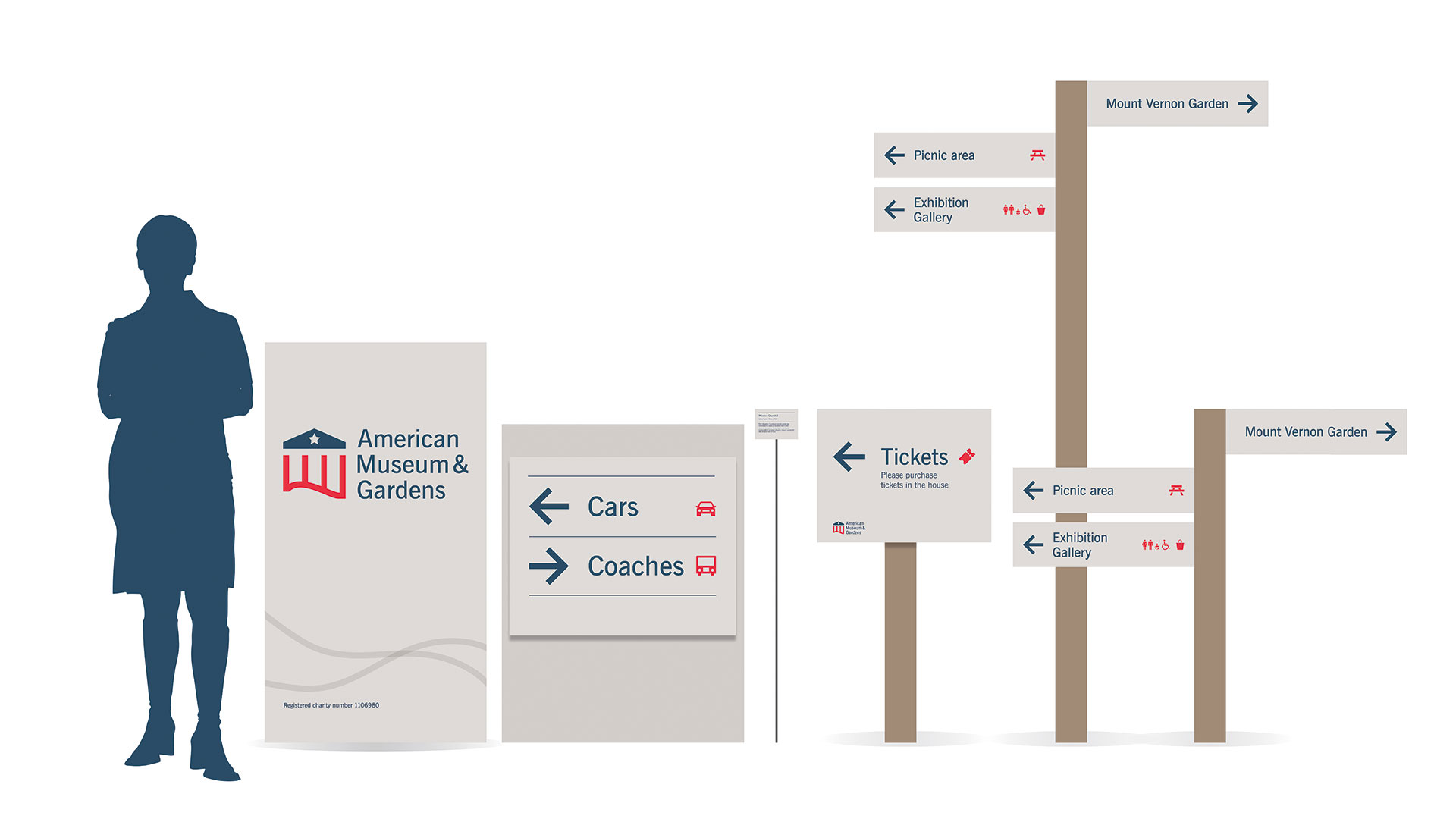
To help the museum’s project team visualise the proposed signage and provide them with a sense of scale, and in order to move the designs forward a pace our project designer Georgia produced a design schematic, showing each sign type in one overview diagram.
A schematic is a quick and simple method to communicate with the client, before going too far with the time-consuming artworking of each individual piece.
4. Stay true to the brand
Insights gained on the initial site walk informed the brand identity, making it easy for the team to produce a seamless visual language. During the walk, the museum director showed Sue a sample of the paint colour that would be used on the new ticket pavilions at the entrance to the garden. This became our secondary colour palette for the brand identity and the signage.
To ensure a consistent brand experience, it is important that the wayfinding is designed as part of the overall brand identity, rather than as a stand-alone design exercise.
5. Respect and reflect the environment
Work with the garden design and the surrounding landscape to avoid breaking sight lines by introducing signs that are too high, too big, or too obtrusive.
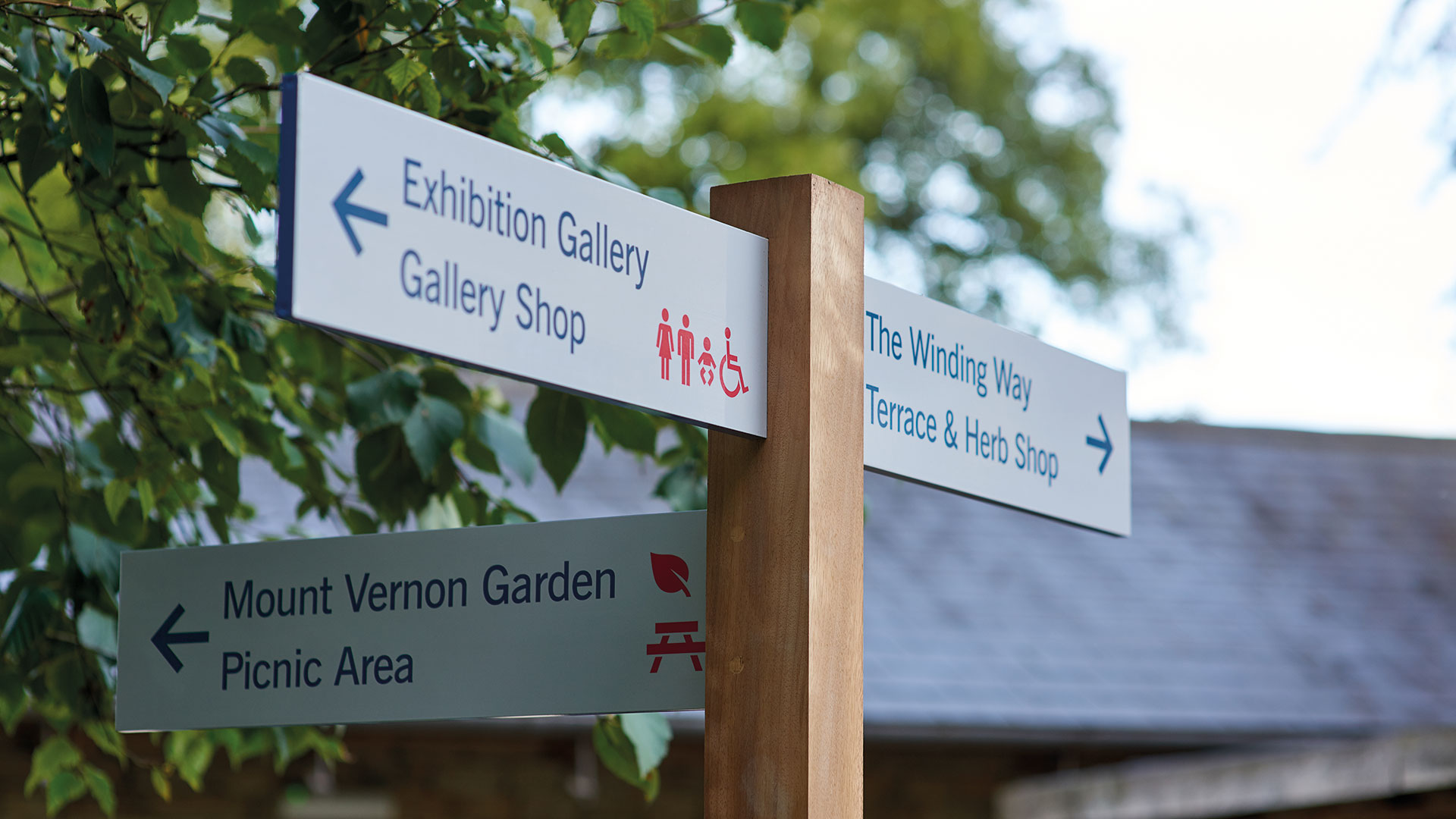
The choice of materials and finish also help to place the signage sensitively within the environment. We chose the West African hardwood Iroko for the posts, which complemented the natural environment.
We worked with the team at Freestyle Design to produce a stylish finish with minimal visible fixings, which was important as Claverton Manor, which houses the museum, is Grade I listed.
Working closely with your supplier and tap in to their knowledge of fabrication techniques to achieve a finish that fits the brief.
6. Consider accessibility
To ensure a perfect experience for children and wheelchair users, we followed established guidelines for optimum viewing heights for signage, while effective use of colour, contrast and scale helped to enhance the clarity and impact of the signs, and used icons for foreign visitors.
Museums are for all to enjoy, so keep the diversity of your visitors in mind at all times.

7. Think about the micro as well as the macro interaction points
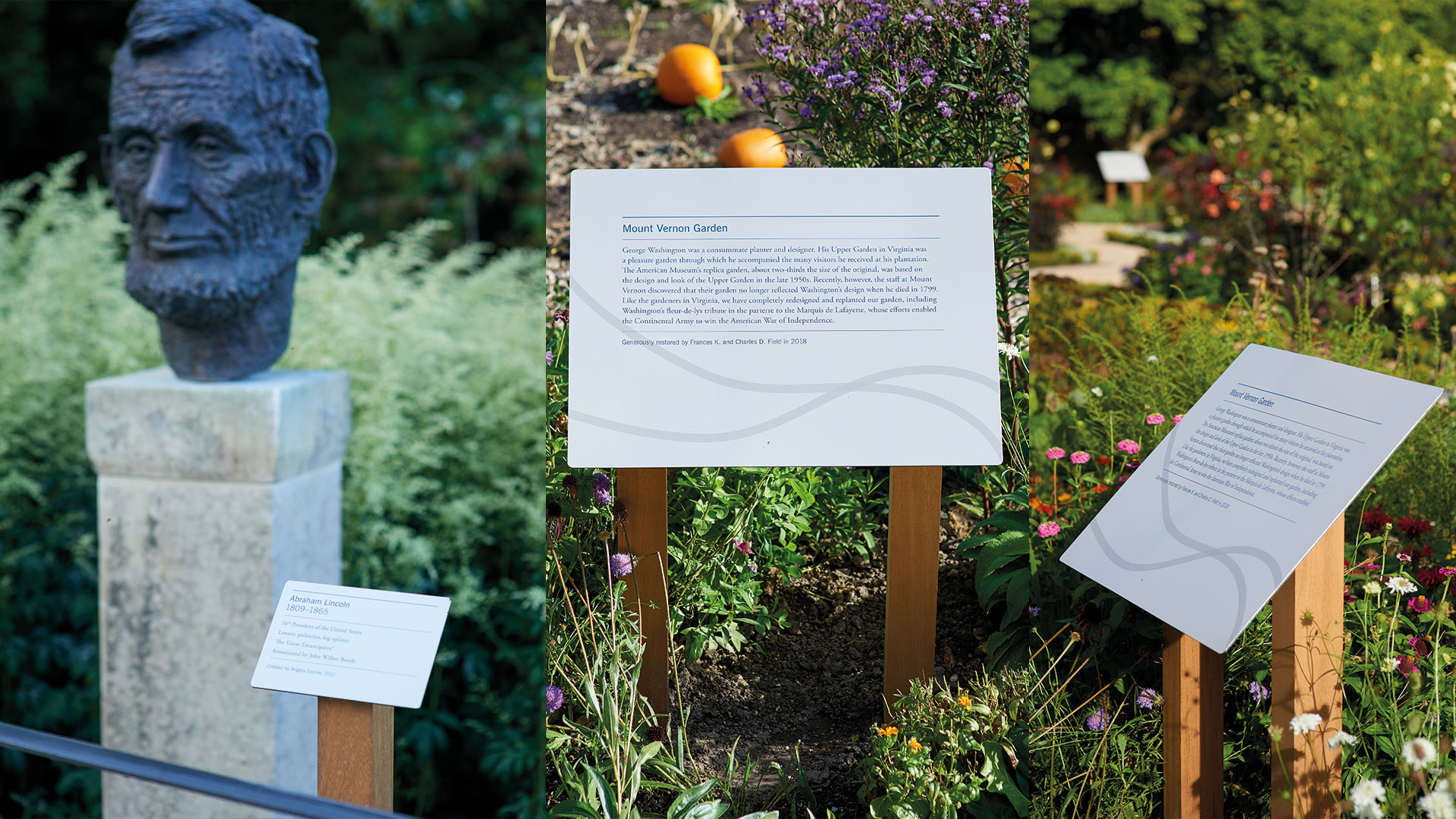
Wayfinding isn’t just about physical signage, printed literature can support the visitor’s journey around the site. We commissioned graphic artist Fi Powers to illustrate an isometric visitor map of the site. We also designed hand held planting plans for the horticulture-lovers to identify the shrubs and perennials in the gardens.

8. Watch and listen
No matter how carefully considered the signage, after the garden has been open for a while, we may have to revisit our assumptions about how visitors navigate the site. The client and the design team have committed to keep an open mind, and we will watch how people use the gardens and respond to their comments and feedback given to staff and volunteers.
We found that if you apply the principles of digital user experience to wayfinding, you can’t go far wrong
Whether designing an app, a website, or a successful wayfinding scheme, the principles are the same: consider user needs, plot user journeys, define clear nomenclature, design for the widest audience and stay true to the brand.
5 Tips for a more successful call to action
In the site planning stage you will have defined with your design agency all primary call to actions across the site (data capture forms, links to product pages etc). The next step for the agency is to design the Call To Action (CTA) so that people feel moved to take action. The CTA must work quickly to draw attention – through visual clues and positioning, and through convincing words.
This infographic outlines 5 tips to creating a successful call to action:

Infographic by Lisa Margetis
Example of an effective CTA
In this website design you will see that we placed the primary call to action in a contrasting colour in the top left corner of the page [1]. We also repeat it further down the page [2]. The form itself sits at the base of every page, the action of clicking the button auto scrolls the page down to the form [3]. The analytics show a very healthy conversion rate: 1 in 5 visitors request a quote after visiting the site.

*The average attention span in 2015 is 8.25 seconds
How should we encourage equality in creativity?

According to the recent publication: Graphic Designers Surveyed, female graduates outnumber men in graphic design, yet, there are few women in senior positions in the industry.
Pentagram is the grandfather of independent agencies, it is the largest internationally, and since it’s beginnings in 1970’s London, it has worked with many global brands. It’s small, but stella list of female partners includes, honoured US graphic artist Paula Scher and British graphic designer and filmmaker, Marina Willer, best known for her work on the Tate Modern brand.
The World Economic Forum recently predicted that it will be another 117 years before the gender gap is removed and women and men co-operate equally: that’s in 2133.
Globally the number of men and women is more or less equal. Women drive 70-80% of all consumer spending. So there are human as well as business benefits in men and women working closely together – bringing diverse insights to the creative process. One thing is certain: we need women at the top.

So how can we achieve parity for women in design?
The theme of International Women’s Day this year is: ‘Pledge For Parity’ – in honour of this we asked a number of high profile, female, senior graphic designers for their thoughts and advice for women getting ahead in the graphic design and creative industries.
A common view from female senior designers and agency owners is understanding the importance, particularly for young women, of confidence, communication and negotiation skills as much as design talent and that this should be taught as part of design education so that women learn how to explain, defend and promote their work.
This thread is further borne out in the Graphic Designers Surveyed report, which revealed that in the field men were more confident, they generally thought their work better than others, they were very comfortable promoting it and happy to speak publicly about it, whilst, women were much less so.
The book unveiled a few more unsightly home truths, despite being thought of as a progressive, open-minded industry, women graphic designers are paid less than their male colleagues; in the UK, women were one and a half times more likely to be earning less than £20k and six times less likely to be earning over £60k.
Morag Myerscough, of Studio Myerscough and design collective, Super Group London, believes that a strong sense of drive is essential to success:
I have always strived for equality and I hope in some way I have added a little bit to this. When I left the Royal College in 1988 there were only 3 girls and 14 boys in my year. I felt very strongly then that I wanted to be successful and better than the boys, which I must admit did drive me on. I did not think anything was going to stop me just my own drive and ability.

Morag Myerscough, photos by: Luke Morgan
Emmi Salonen, Founder and Creative Director of Studio Emmi has this advice:
In graphics it’s vital to network, to be inquisitive and bravely curious in order to go forward. Enquire, be affirmative, find out and explore how everything works from getting work, designing, and the whole print process. Sharing information, learnings, new styles, fonts, resources – it’s all such a vital part of the profession.
Lynne Elvins, Design Strategist, Director and Founder of Design Rally and former Vice-Chair of the West of England Design Forum believes there is good news:
I genuinely believe that we are seeing a shift to a more entrepreneurial, creative and innovative style of business. Evidence points out that emotional intelligence, collaboration and ‘soft skills’ (which are more female) are valuable. Diversity and inclusivity are also highly positive for workplaces. I feel very encouraged that young men and women already know this so it is, hopefully, only a matter of time before we see design teams change.
This change is taking place from the ground up, momentum is beginning to really pick up especially with events like WOW, Women of the World, Festival which is taking place in London this month, which will be seeking to honour and celebrate women who are: ‘breaking the mould and leading the way across the creative sector’.
Meanwhile, working at the grassroots of education is, The Girlhood, a project created by former teacher Natalie Rodden and Kati Russell – previously a senior programme manager at D&AD, which introduces girls (11-24yrs) from low socio-economic backgrounds to the skills they will need to get ahead in creative industries. Their aim is to bring a richer mix of females into the creative sector and feedback into the industry the insights, learning and values discovered through this project along the way. The Girlhood motto: ‘Fearless Females Pioneer Change’, should ultimately be the maxim for us all and through this belief we will inspire, promote and bring about equality in creativity far faster than the WEF will have us believe.
Talented women in design:
33 Women Doing Amazing Things in Graphic Design
References:
Pentagram
Paula Scher
Marina Willer
Graphic Designers Surveyed
World Economic Forum
DCMS Report
How can a rebrand help your business? 5 reasons why…
Before we consider the ‘whys’, let’s take a step back and look at the definition of a brand. A brand is so much more than just a name, logo or motif. Put simply, your brand is what your clients and prospects think of when they hear your brand name – both visual, and emotional.
A rebranding exercise involves taking an in-depth look at: your products/services, your marketplace, your unique selling point, your competitors, your brand attributes and the emotional benefit customers experience through your brand.
How can a rebrand help your business?
A good brand can help a business reach more of the right customers, charge higher prices and ensure a more consistent flow of business. A good brand can also attract the right staff and partners, give a business more credibility and help demonstrate leadership. This all sounds great right but how is this achieved? The key is to work with an agency that has a good track record in developing brands.
When is it the right time to re-invest in your brand?
In the early years budgets can be tight. When businesses grow they have the opportunity to reinvest their profit in reviewing the strength and impact of their brand, and boost their position in the marketplace.
Businesses commonly invest in a rebrand when:
- They realise that their original branding now looks dated and/or poorly designed and they want to project a more professional image.
- They’ve diversified and expanded and their business name no longer reflects the products or services they offer.
- They have merged with another company and it’s of benefit to reflect this partnership in their brand identity.
- The business has suffered some brand damage or their name/identity is similar to another of ill repute and they wish to relaunch or reposition their business.
- There is some confusion about what their business actually does on first glance.
Examples of rebranding successes and failures
Encapsulating a company’s goals, message, and culture into one brand is no mean feat. To truly achieve an outstanding brand that reflects every aspect of a business takes the skills of an experienced brand specialist.
Let’s look at logo redesigns. Your logo is not your brand, nor is it your identity. Logo design, brand identity design and branding all have different roles to play but collectively, they form a perceived image of a business, product or service. If you are interested in this definition then read more on it here.
Here are some examples of companies who have revived their fortunes by reinvesting in their brand:

Rather than one sudden rebrand Google has evolved over its lifetime. The latest iteration of the logo is designed to be legible on the tiniest of digital devices, whilst at the same time maintaining established brand attributes with a simple, uncluttered, colourful and friendly logo.

Brunel Shipping
Sometimes it’s more beneficial for a business to refine its brand rather than starting from scratch. Brunel Shipping have nearly 30 years in business. Completely reinventing their logo would risk losing recognition and consistency. At Touchpoint, we took the approach that the logo needed to be brought up to do date, redrawn to reflect their professional approach to business and to improve legibility when used across print and digital media.

Science Council
The original logo for the Science Council was developed before the organisation had matured. Now out of their infancy, we advised them to create a new logo which represented their brand attributes – Inclusive, Balanced, Positive, and Collaborative. The typography and colour of the original brand identity looked more to the past than the future so we selected a modern typeface and a bright and bold colour palette which was fresh, modern and accessible. Read more about this rebrand here.
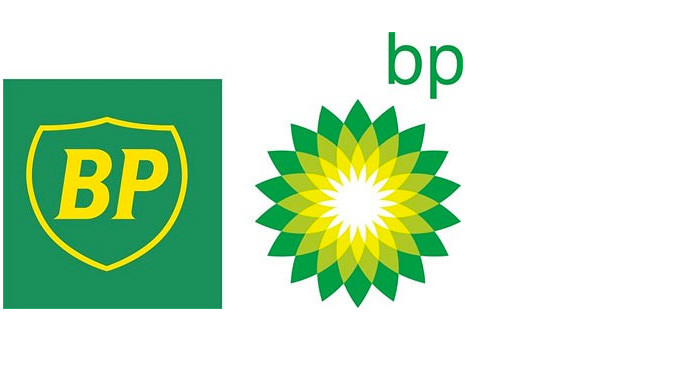
BP
Not all rebrands are a success. BP replaced a strong logo that had been with their company for around 70 years and replaced it with their current logo design. They sought to project a soft more environmental image, however, a change of this nature must be authentic and compelling. Environmentalists were not convinced and the change generated a lot of bad press. Ten years after the launch of the new logo, BP were responsible for what is considered the largest marine oil spill in the history of the petroleum industry – proving that you must live by your brand messages or suffer the consequences.
There is no need to fix what isn’t broken, you risk losing customers and followers. Rebrand for the right reasons and not just to stir things up.
Once you’ve been through the rigorous process of branding and you’re happy with your key brand messages and visual identity, don’t forget to do two things.
- Live and breathe your brand within the business, and externally.
- Be consistent and constant in the execution of your brand messages.
